
Atlanta City Directory Years and Shelves
Fulton County Library System Central Library Special Collections holds Atlanta City and Suburban Directories and Haines Criss-Cross Directories. The official Atlanta directory collection page describes city-directory coverage from 1859–60 through 1991, when publication ceased. It highlights the 1867 volume within its comprehensive collection. Haines coverage begins in 1946 and continues through 2016–2017.
| Collection | Years | Where held | Access |
|---|---|---|---|
| Atlanta city/suburban directories | 1859–60 to 1991 | Central Special Collections | Walk-in; selected digital copies |
| Haines criss-cross | 1946 to 2016/17 | Central Special Collections | Walk-in by address or phone |
| Georgia census microform | 1820–1880, 1900–1930 | Georgia Collection | Reading room |
| Fulton deeds/mortgages | 1850–1931 | Georgia Archives | Finding aid and on-site |
| House-numbering maps | 1926 | Georgia Archives | Archival series access |
All library city directories are available for walk-in use. Questions may be sent to Library.SpecColl@fultoncountyga.gov. Appointments are encouraged for maps and vertical files. Those physical routes matter because not every volume or page is online.
Review the library's official Atlanta city directory collection and stated year runs.
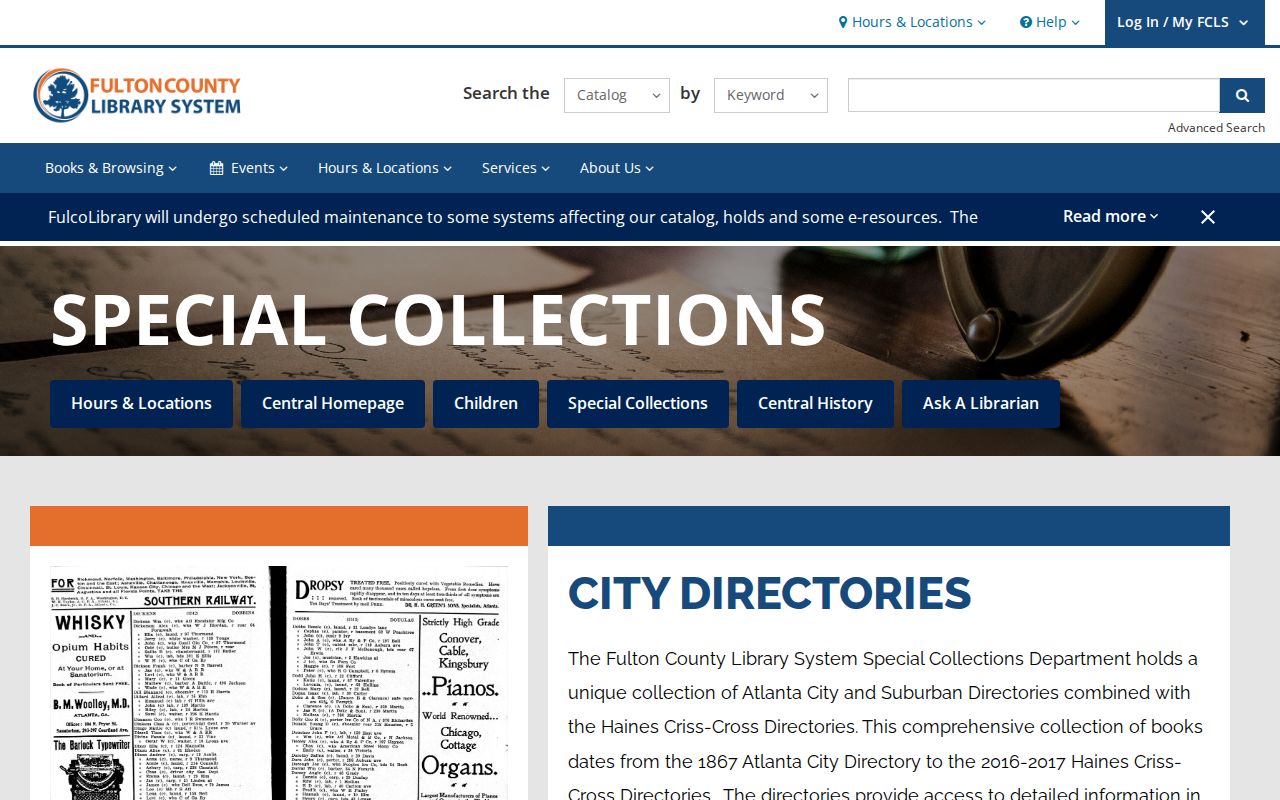
The library page anchors both the alphabetical and reverse-directory timelines before a researcher selects a volume.
Read an Atlanta City Directory Entry
An alphabetical entry commonly gives a surname, first name or initial, spouse in parentheses, widow notation, occupation or employer, business address, and home address. Later books may add a phone number. Street guides can arrange occupants by house number and identify cross streets, firms, and institutions. Always photograph or transcribe the abbreviation key for the exact volume.
| Name | Head or listed person, often with initials |
|---|---|
| Spouse | Name in parentheses in many editions |
| Work | Occupation, employer, or business address |
| Home | House number, street, and directional |
| Status marks | Widow notation, rooms, boards, or other shorthand |
- Criss-cross directory
- A reverse book that begins with street address or phone and returns the listed name.
- Householder index
- A section grouping people or premises by address rather than only surname.
- Abbreviation key
- The volume’s own legend for marks such as h, r, emp, clk, and wid.
“H” often means home; “r” can mean resides or rooms; “emp” means employed; “clk” means clerk; and “wid” marks a widow or widower. Meanings can vary, so use the printed key instead of assuming.
Atlanta Directory Research at Central
The Georgia History collection extends far beyond directory books. It includes census microforms, local newspaper microfilm, vertical files, and maps. Hard-copy maps run from the late nineteenth century into the 2000s, while copies in the larger map collection date much earlier. Atlanta USGS topographic sheets from 1927–29 can help place a district during the same era as a directory entry.
Bring a full name and spelling variants, an exact address with quadrant, approximate years, spouse, occupation, and any prior deed or census citation. Ask staff for a collection or finding aid rather than an open-ended person search. Record the call number, volume year, page, box or folder, and access date.
See the Central Library Georgia History collection and its research scope.
The collection page confirms that maps, newspapers, census material, and vertical files can test a directory finding without leaving the local history room.
Search Atlanta Directories Online
The Digital Library of Georgia routes researchers to digitized books, maps, photographs, newspapers, and directory material. Search a full name in quotes, then try surname and street, spouse, occupation, and initials. Georgia Historic Newspapers is especially useful for death notices, legal advertisements, society columns, and address events that explain why a name changes or disappears.
Digital text recognition can fail on narrow columns, worn type, and abbreviations. Browse page images when a text search returns nothing. Search both the alphabetical list and the street section. Download or note the title and year because a loose search-result snippet is weak evidence.
Open the Digital Library of Georgia search used for Atlanta collections.

The digital catalog offers remote discovery, while the Central Library fills gaps left by incomplete scanning or text recognition.
Reverse Atlanta City Directories After 1946
Haines volumes change the starting point. Instead of knowing the resident’s surname, begin with the street and house number or a phone number. This is useful when a deed names an owner but the family question concerns a listed occupant. Compare both sides of a target year because directory canvassing occurred before publication and not every household answered.
The 1946 start is a firm boundary. Earlier address work depends on street sections in regular directories, census schedules, deeds, maps, and newspapers. Haines ends in 2016–2017, so it should not be treated as a current roster. The collection records what the publisher listed at a date.
The roughly century-and-a-half span is notable: alphabetical Atlanta city directories reach 1991, while the later reverse series extends the address-first method by another quarter century.
Trace Families Through Atlanta Directories
Annual books can narrow a move, marriage, death, or work change to a much smaller period than the ten-year census cycle. Start with a year close to a known event, then move backward and forward one edition at a time.
- Find the person in the alphabetical section and copy the entry exactly.
- Check spouse, occupation, employer, home address, quadrant, and every abbreviation.
- Inspect adjacent years and the street section to test a move or omission.
- Pair 1870, 1880, and 1900–1950 observations with public federal census households.
- Use an obituary, probate file, deed, or later volume to explain the trail’s end.
The National Archives census research portal explains federal access. Under the 72-year rule, the 1950 census is the latest public population schedule as of 2026. Census data can add family relationships and ages that a directory omits.
Review the National Archives census research route paired with Atlanta directory years.
Census households provide a periodic check between annual listings and help distinguish one same-name Atlanta resident from another.
Fix Atlanta Directory Number Changes
Georgia Archives series 160-20-016 contains Atlanta house-numbering maps created in 1926. A sudden address change may be a municipal renumbering rather than a household move. Compare the old and new number, then use a plat, legal description, or Sanborn fire-insurance sheet to keep the building itself in view.
The Archives also identifies Atlanta Waterworks blueprints, surveys, and plats from 1917 through 1932. Fulton County’s creation from DeKalb in 1853 and its absorption of Campbell and Milton in 1932 can change the county name attached to older material. The land may remain fixed while the catalog jurisdiction changes.
Note: Preserve the printed street name and quadrant before trying a modern spelling in an Atlanta city directory search.
Atlanta Maps and Newspapers Add Context
Sanborn fire-insurance maps show building footprints, construction, use, and street numbers, but do not name occupants. The Library of Congress Sanborn collection, Digital Library of Georgia, and library resources provide the documented access routes. Confirm the sheet and edition for the address rather than assuming complete Atlanta coverage.
Church registers, funeral programs, cemetery plot records, yearbooks, and historic newspapers can fill gaps. This is vital for pre-1919 life events and for residents omitted or poorly indexed in segregated-era mainstream publications. Auburn Avenue Research Library, Atlanta University Center collections, Atlanta Daily World, churches, funeral sources, and cemeteries are especially important routes for African American family research.
Each companion source needs its own caution. A map describes a structure, a newspaper reports an event, and a cemetery file may identify lot ownership or interments. None should be made to say more than it records.
Atlanta Directory Sources Change by Era
Nineteenth-century Atlanta research leans on deeds, census schedules, city books, churches, newspapers, and cemetery evidence. The directory run begins before Fulton County’s modern borders settled, so DeKalb, Campbell, or Milton records may be part of the same family trail. For events before statewide birth and death coverage began in 1919, local religious and burial records can become essential companions.
Streetcar-era homes benefit from annual directories, plats, permits, and Sanborn sheets. The 1926 numbering maps help carry one house across a changed number. After 1946, Haines adds an address-first route. Recent condominium research needs the unit parcel and recorded condo plat because one street address may stand for hundreds of distinct owners.
This timeline explains why a search method should change with the target year. It also prevents a missing database result from being mistaken for missing history.
Atlanta City Directory Limits
Publication lag is the first limit. A person may have moved between canvass and printing. Some residents declined listing, used initials, appeared under a spouse’s name, or were omitted. Name spelling and occupational shorthand can shift from one volume to the next. Absence from an Atlanta city directory never proves absence from Atlanta.
Street names and directional suffixes also create false matches. Peachtree Street, Peachtree Road, West Peachtree Street, and other Peachtree-named roads must stay distinct. A house number without NE, NW, SE, or SW may point to the wrong segment.
Confirm important findings with two independently issued records. A directory plus census household, deed book/page, probate file, or dated newspaper item is stronger than repeated copies of the same listing. For modern address-keyed ownership, use the Atlanta street directory workflow rather than stretching a historic volume beyond its date.