
How to Find Atlanta Residents
A useful Atlanta residents directory search begins by matching the question to the record. An address can lead to a parcel owner through the Fulton County Board of Assessors or to planning and jurisdiction details in Atlanta Property Information. A name can lead to deeds, court cases, professional licenses, corporation filings, or an entry in a dated city directory. An approximate decade points toward the Central Library, census schedules, newspapers, or archival maps.
Official records document transactions and legal status, not a complete household. A parcel card identifies the assessed owner and tax mailing address; it does not list every occupant. Voter data omits people who are not registered and shields confidential fields. Directories reflect what a publisher collected at a particular time. Treat each result as dated evidence and confirm an important identification in a second independently maintained source.
- Resolve the city limits, county, quadrant, and parcel before choosing a custodian.
- Check the appropriate county property roll by exact address or owner name.
- Use Georgia My Voter Page only for the voter's own registration record.
- Follow ownership into the GSCCCA grantor-grantee deed index.
- For an earlier household, consult Atlanta city and Haines criss-cross directories.
- Request an offline record from its custodian under the Georgia Open Records Act.
Offices Behind Atlanta Resident Records
Atlanta records are divided by both subject and geography. The Fulton County Clerk of Superior and Magistrate Courts records deeds, liens, plats, UCCs, trade names, and court material. The Board of Assessors maintains parcel ownership and valuation. Fulton Probate Court handles estates, wills, guardianships, and marriage licenses. Georgia agencies maintain voter, vital, business, and professional-license records. Because Atlanta extends into DeKalb County, first confirm the county; the Atlanta street directory explains the address-first route.
Fulton County Real Estate Division
136 Pryor Street SW
Atlanta, GA 30303
404-613-5313
Fulton County Board of Assessors
235 Peachtree Street NE, Suite 1400
Atlanta, GA 30303
404-612-6440
Georgia Secretary of State Elections
2 Martin Luther King Jr. Drive
Atlanta, GA 30334
404-656-2871
Atlanta Addresses Cross Two Counties
The most important local trap is geographic: most of Atlanta lies in Fulton County, but a substantial eastern portion lies in DeKalb County. An “Atlanta” postal city does not establish that an address is inside the municipal boundary, and a 303xx ZIP does not establish Fulton jurisdiction. County deeds and taxes may continue across a period when city permits or NPU membership changes through annexation.
Use the City Limits Address Lookup or Atlanta Property Information to establish city status, then confirm the parcel and county. Preserve the quadrant—NE, NW, SE, or SW—and the complete street name. Peachtree Street, Peachtree Road, and West Peachtree Street are different search keys. A unit number also matters because one condominium building can contain hundreds of separate parcels.
Key distinction. Situs is the physical property location; the tax mailing address is where notices go. They can name different places and people.
Read the Fulton Property Roll Carefully
The Fulton County property search accepts owner, address, and parcel routes. A parcel record can supply the owner name, situs, tax mailing address, parcel identifier, legal description, land and improvement values, building characteristics, exemptions, and recent sales. These fields make it a strong starting point for connecting an address to the legal owner.
Ownership is not occupancy. A company, trust, estate, or nonresident owner may appear while the people at the property do not. Apartment renters and household members generally will not be named. For a condominium, select the unit parcel rather than relying on the master or common-area parcel. The parcel ID and legal description are especially useful because they remain better continuity keys than a street number.
Move From an Atlanta Parcel to Its Deed
The assessor's sale line is a clue; the recorded instrument is the transaction evidence. Search the GSCCCA Real Estate Index by grantor or grantee, county, date range, and instrument details. Inspect the deed image when available and capture the recording date, book and page or instrument number, legal description, and the parties' names. To walk backward, search the current grantee as a later grantor and repeat while the legal description stays consistent.
The Fulton Clerk also provides a records room and staff channels for plats and land records when an image or older instrument is not online. Georgia Archives holds Fulton deeds and mortgages dated 1850–1931. That offline route matters because the research did not establish one exact electronic-image cutoff. The statewide index pictured below shows why names and instrument identifiers work together.
Open the official Georgia deed index before comparing a parcel sale.
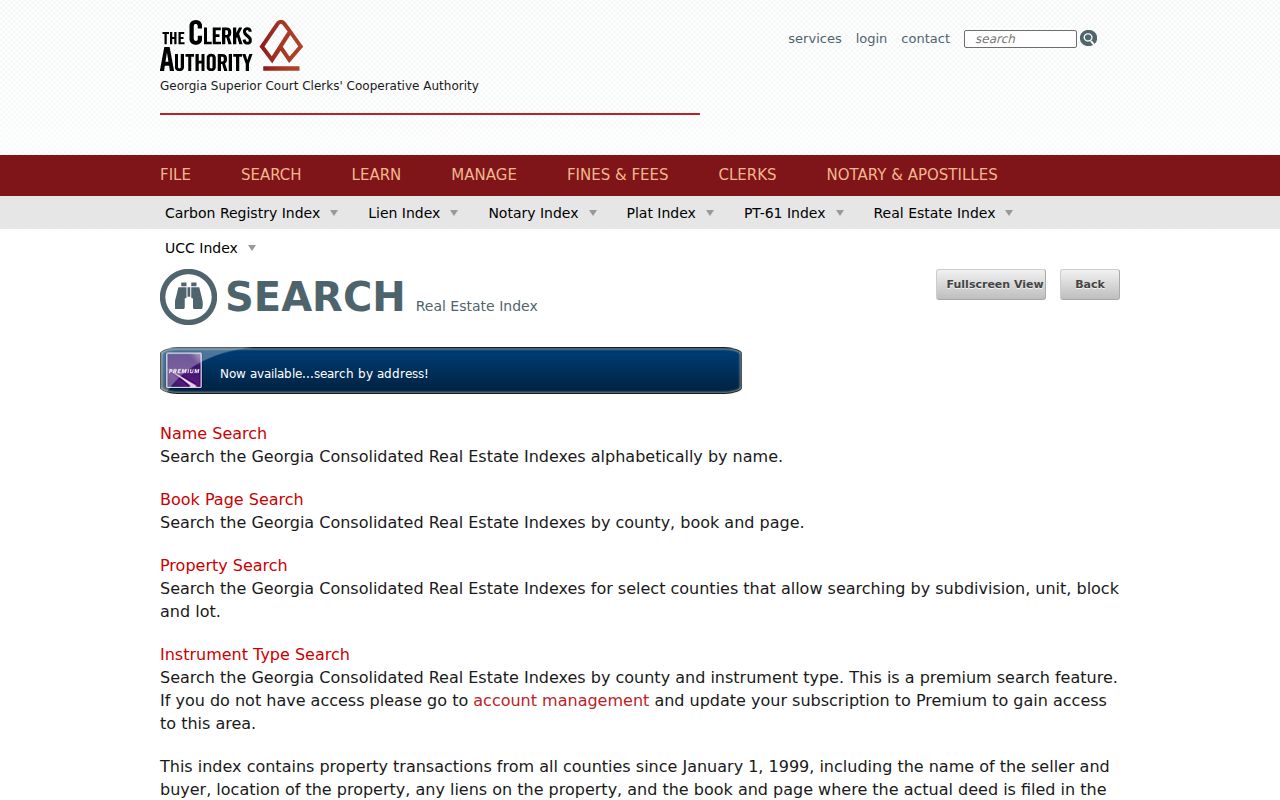
The index locates the filing; the recorded deed supplies the authoritative description and transaction details.
Georgia Voter Records Have Two Access Paths
Georgia My Voter Page is a self-lookup requiring first initial, last name, county, and date of birth. It returns registration status, registered address, precinct and polling place, elected districts, sample ballot, and participation history. Georgia does not register party affiliation, so participation history should never be presented as a declared party.
The public statewide voter list is a separate purchased dataset governed by O.C.G.A. §§ 21-2-225 and 21-2-234. Social Security numbers, driver or ID numbers, month and day of birth, email addresses, and phone numbers remain confidential. A person looking for someone else cannot use MVP as a general people-search form. The official interface illustrates the required identity fields.
Review the Secretary of State's My Voter Page lookup.
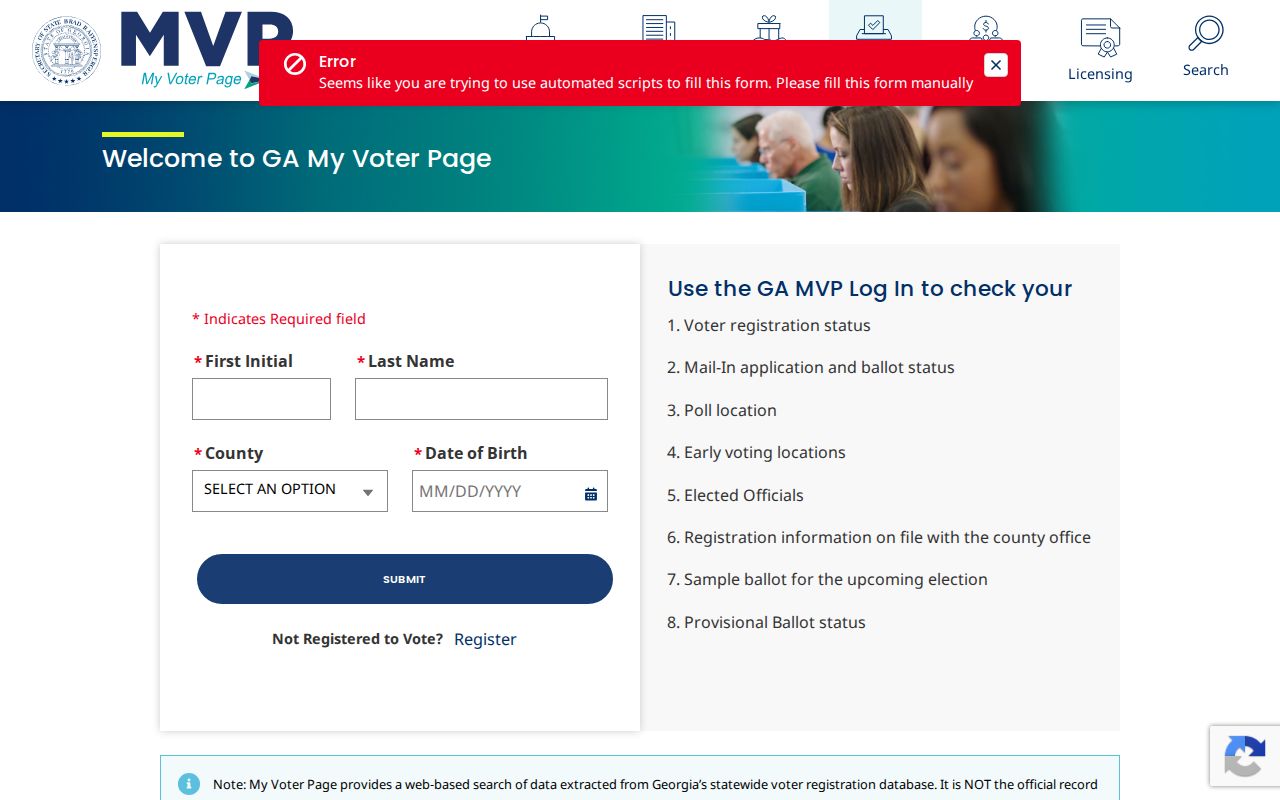
Its limited inputs reinforce the difference between checking one's own registration and obtaining a lawful public list.
Current Atlanta Resident Directories
No current source lists every Atlanta household. Instead, public rolls identify people by a specific legal relationship: parcel owner, registered voter, party to an instrument, court party, licensed professional, corporate officer, or public employee. Start with the narrowest official source and record its date. For one-person research, the Atlanta resident lookup sets out a verification stack.
| Source | Who It Lists | Keeper | Access |
|---|---|---|---|
| Property roll | Assessed owners | County assessor | Free online search |
| Voter record | Registered voter | Georgia Secretary of State | Self-lookup; public list by law |
| Real-estate index | Grantors and grantees | Superior court clerks | Online index and clerk records room |
| Business and license indexes | Entity principals and licensees | Georgia Secretary of State | Free name searches |
| NPU directory | Public civic contacts | City of Atlanta | Online directory |
A property roll answers ownership, not household composition. A deed index shows parties to a recorded transaction. An NPU directory identifies public organization contacts, not a private member roster. Business and professional-license searches can distinguish a same-name person by entity, license type, address, and status, but those records document the licensed or corporate role rather than residence.
Atlanta Courts Require a Portal Map
There is no single complete Atlanta court-name search. Fulton Superior, State, and Magistrate courts use county public-access services; Probate Court makes estate material available through its records division and re:SearchGA; Atlanta Municipal Court provides document and transcript request forms; and federal Northern District of Georgia cases are searched through PACER. Georgia's e-access directory helps select a court and provider.
Search by name variants, then verify court, case number, filing date, party role, and an address appearing in the actual filing. A docket is a locator, not proof that two people with the same name are identical. The 2025–2026 Georgia Court Case Management System project aims to improve statewide administration, but it does not mean every legacy Fulton record has moved into one public system.
Use Georgia Courts' official provider directory to choose the proper court system.
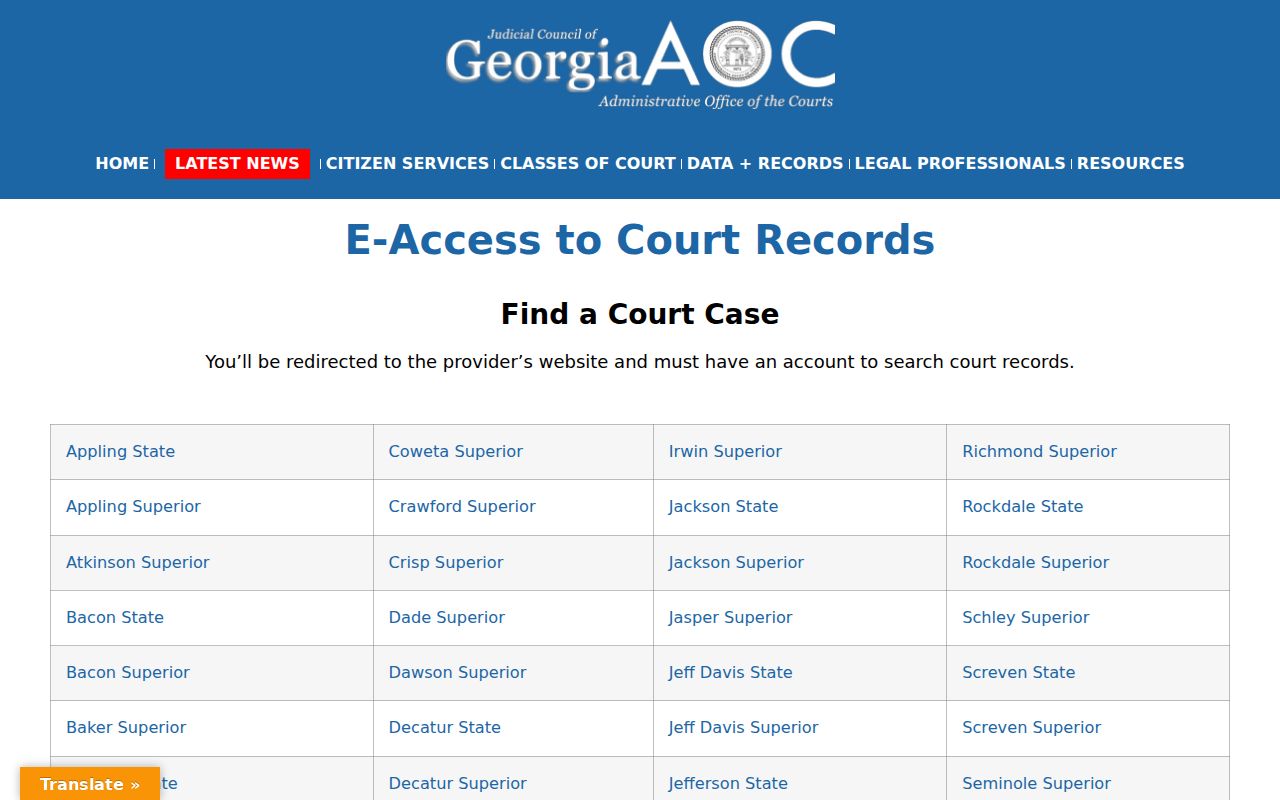
The provider-selection screen is a reminder to identify jurisdiction before searching a person's name.
Request Atlanta Records That Are Not Online
The Georgia Open Records Act, O.C.G.A. §§ 50-18-70 through 50-18-77, generally requires acknowledgement, production, or a timetable within three business days. Direct a focused request to the agency that created or keeps the record. State the record type, date range, names, address or parcel, preferred electronic format, and a willingness to narrow the request if needed. Ask for an estimate before authorizing extensive search or copying costs.
The Georgia Attorney General's request guide includes practical instructions and a model. Atlanta has a designated city request gateway, while Fulton County routes requests through county custodians. A request cannot override sealed, confidential, or record-specific access restrictions.
Read the official Georgia open-records instructions before drafting a request.
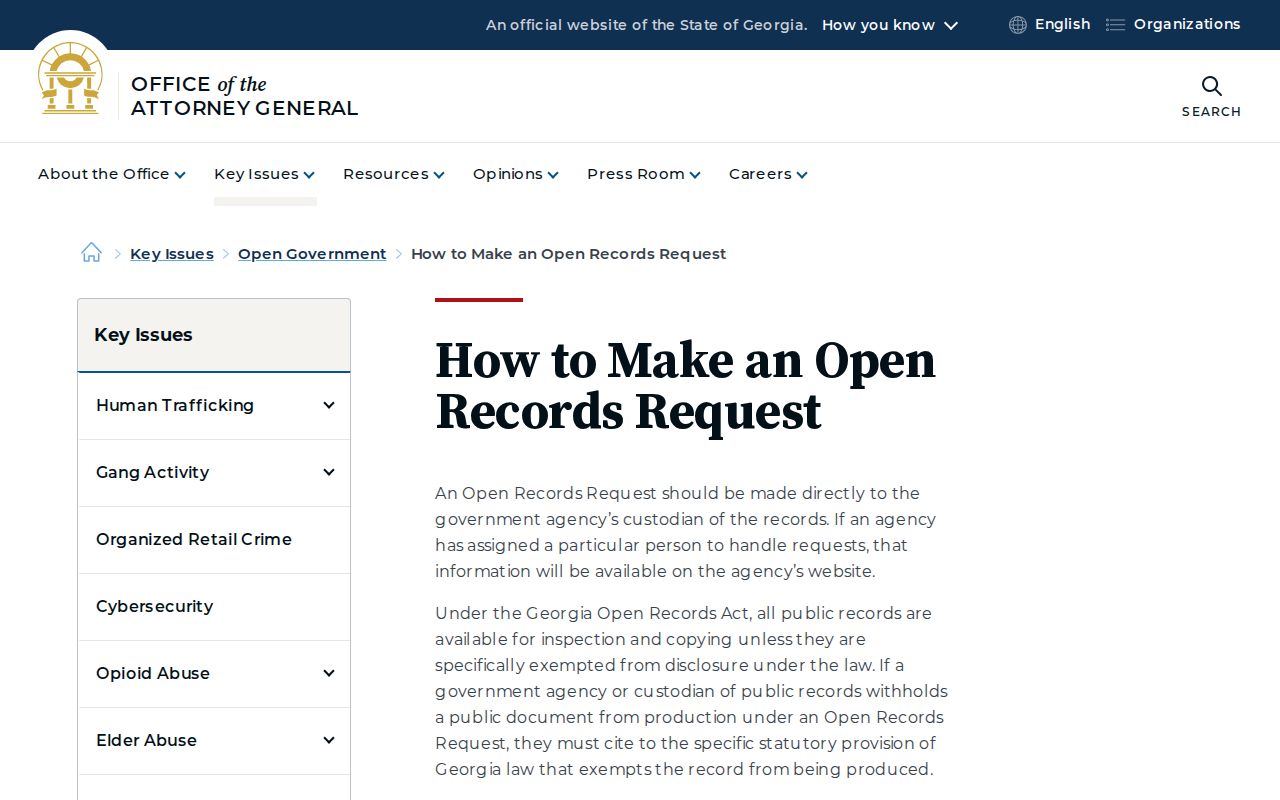
A precise description gives the custodian a reproducible search and reduces avoidable delay.
Vital Records Identify Events, Not an Open Roster
Georgia Department of Public Health holds statewide birth and death records from January 1919 forward and accepts eligible requests online, by mail, or at the State Office of Vital Records at 1680 Phoenix Boulevard in Atlanta. Fulton County Board of Health is another local channel. Fulton Probate Court issues marriage licenses and copies; divorce decrees come from the court, while DPH provides verification.
Birth certificates are restricted under O.C.G.A. Title 31, chapter 10 and Rule 511-1-3-.33. Death records have applicant rules, with narrower eligibility for cause-of-death information. Birth records transfer to the archives after 100 years and death records after 75 years under O.C.G.A. § 31-10-25. These limits are lawful dead ends, not invitations to seek sensitive data elsewhere.
Check Georgia DPH's current order methods and eligibility guidance.
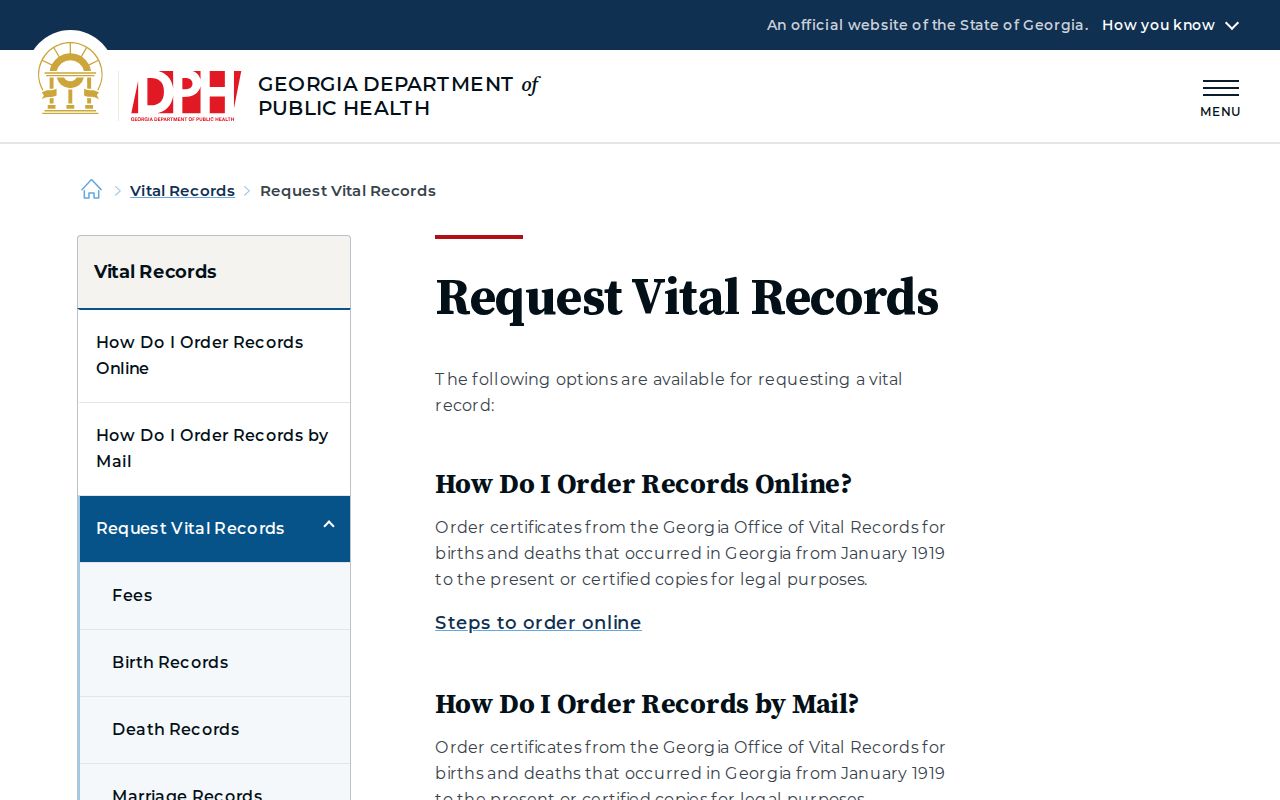
The request page separates available channels from the legal right to receive a particular certificate.
Historical Atlanta Resident Directories
Fulton County Library's Central Library Special Collections holds Atlanta city directories from 1859/60 through 1991 and Haines criss-cross directories from 1946 through 2016/17. Alphabetical volumes connect names with addresses, spouses, and occupations; criss-cross volumes reverse the approach so a street and house number lead to listed occupants and nearby entries. The Atlanta city directory page explains the shelf, abbreviations, and year-by-year method.
A directory entry establishes that a publisher associated a listed person with an address at that publication date. It is not proof of every resident. Search initials, spouse names, spelling variants, occupations, and directional abbreviations. Pair a promising entry with a deed, public census, obituary, newspaper, or probate file before drawing conclusions.
Atlanta Sources Change With the Era
Nineteenth-century work often begins with deeds, surviving censuses, newspapers, church or cemetery records, and the earliest directories. For events before statewide vital registration in 1919, congregation, funeral, obituary, and archival sources become more important. Streetcar-era houses can be traced through directories, Sanborn maps, plats, permits, and the City of Atlanta house-numbering maps created in 1926.
After 1946, Haines reverse directories make an address-first search possible. Public federal census schedules currently extend through 1950 under the 72-year release rule. Modern searches shift to parcel, GIS, permit, court, license, and entity databases. Preserve every citation—volume year, page, instrument number, parcel ID, or case number—so another researcher can repeat the work.
Fulton's 1932 Boundary Story
Fulton County was created from DeKalb County in 1853 and absorbed Campbell and Milton Counties in 1932. The land did not move when the courthouse name changed, so older deeds, probate files, and census entries may be cataloged under DeKalb, Campbell, or Milton. Georgia Archives identifies Fulton deed and mortgage material from 1850–1931, showing why a blanket claim that all early courthouse records disappeared would be wrong.
The same geographic care applies inside Atlanta. Annexation can change when city permits and NPU records begin even though a county deed chain continues. Research the jurisdiction appropriate to the year, not merely the name currently printed on a mailing label.
Protect a Same-Name Atlanta Match
Common names demand two independently issued identifiers. Pair a parcel with a deed book and page, a case number with a party address, or a license number with an entity filing. Compare middle initials, spouse or associate, occupation, age band, street quadrant, and dates. A cluster of websites can still repeat one mistaken source; two official records with distinct provenance are stronger.
Safe at Home gives eligible survivors a substitute address and forwarding service. Do not infer or republish an actual address behind that substitute. Georgia stalking law, O.C.G.A. § 16-5-90 et seq., and harassing-communications law, § 16-11-39.1, can apply to misuse of personal information. Resident research is appropriate for genealogy, reconnecting, estate questions, civic transparency, or verifying a transaction—not surveillance or intimidation.